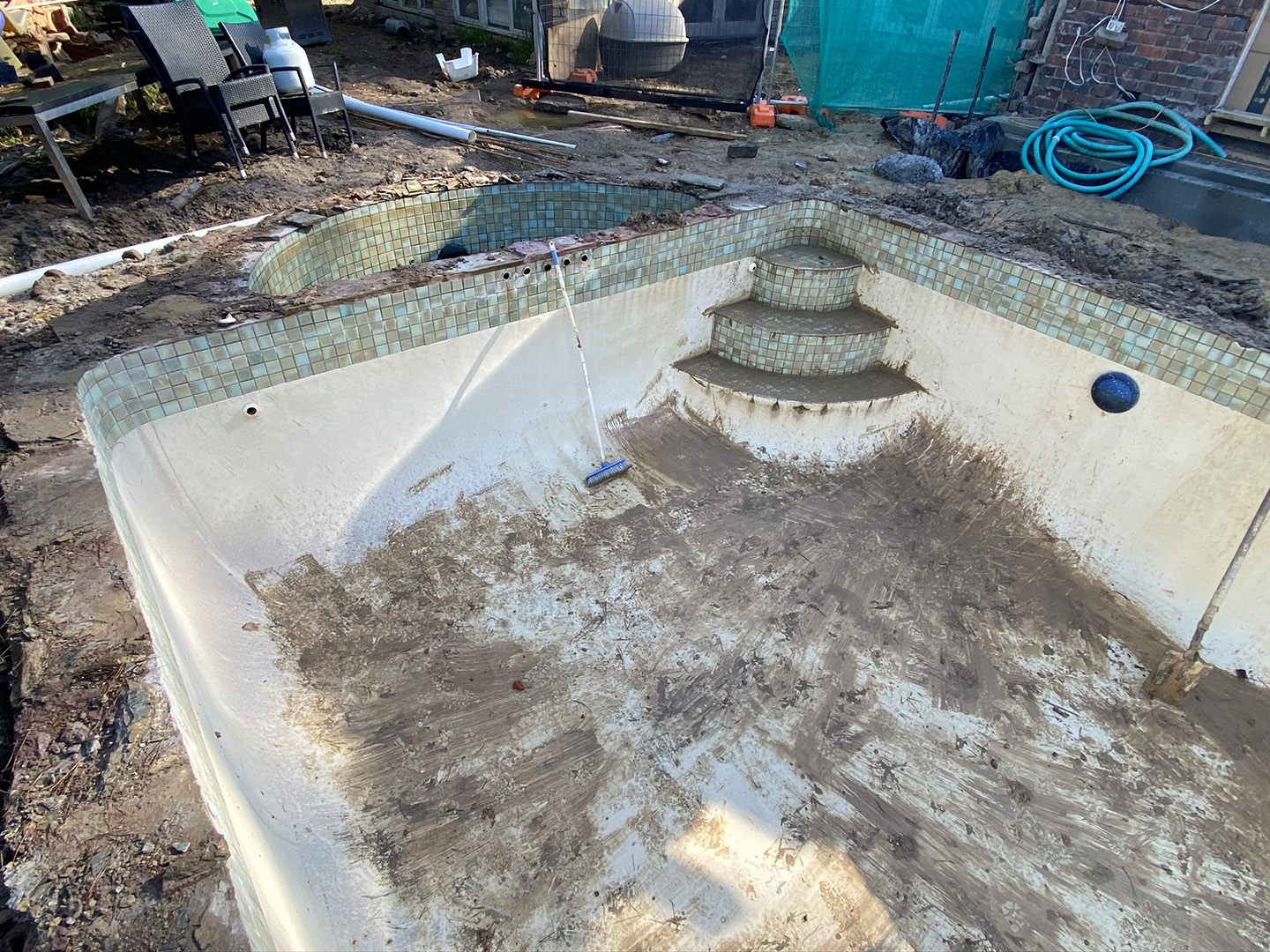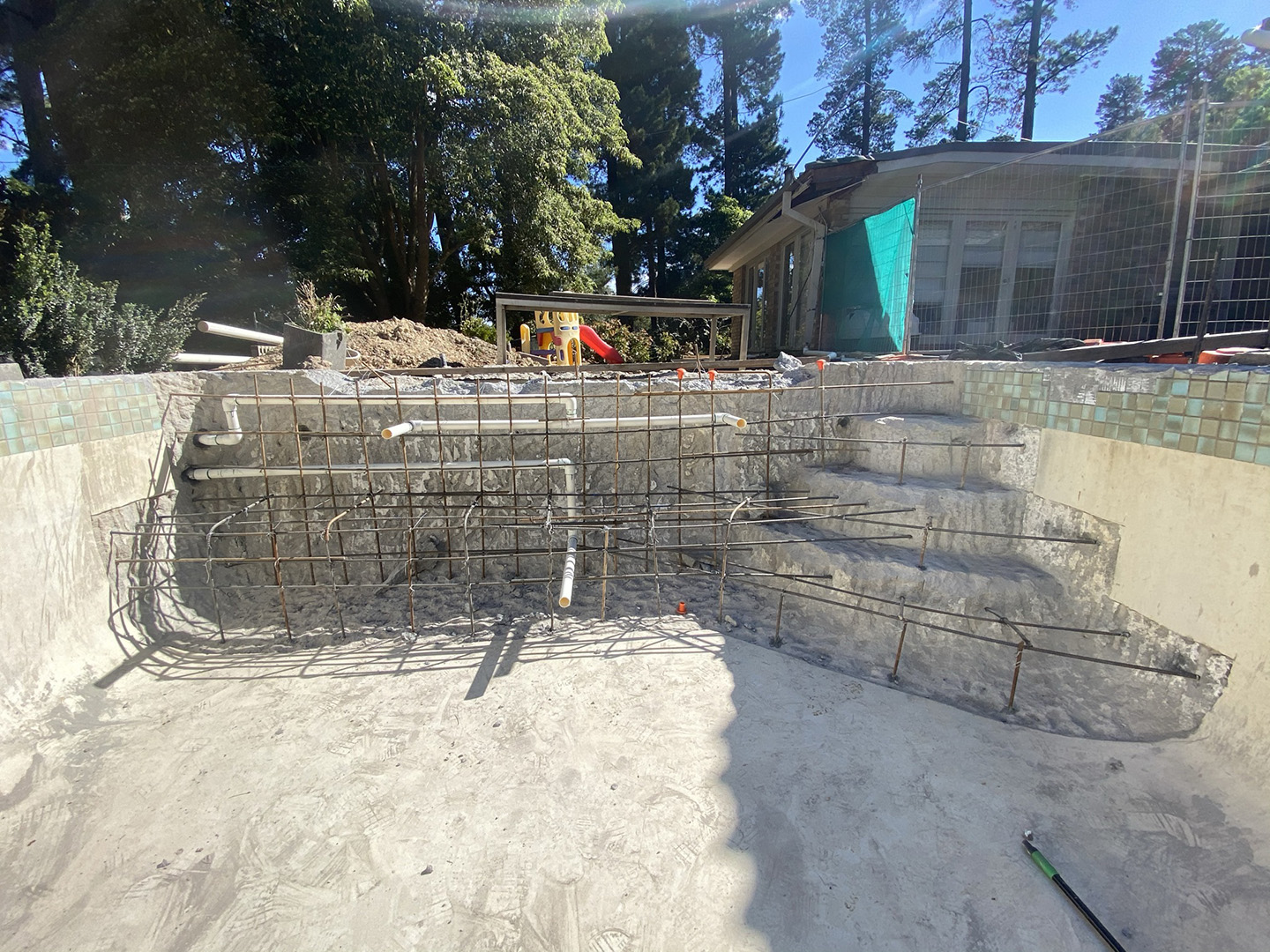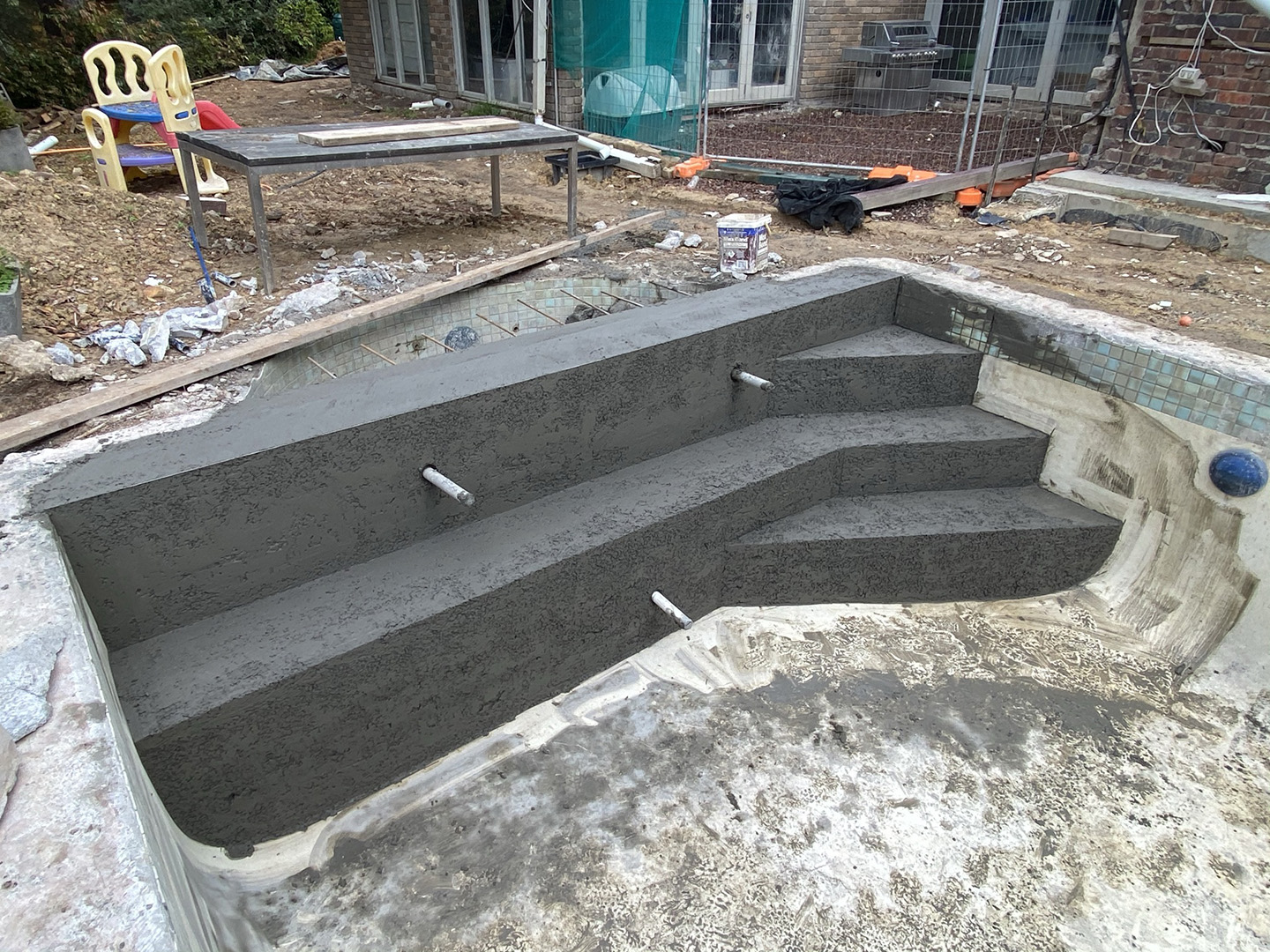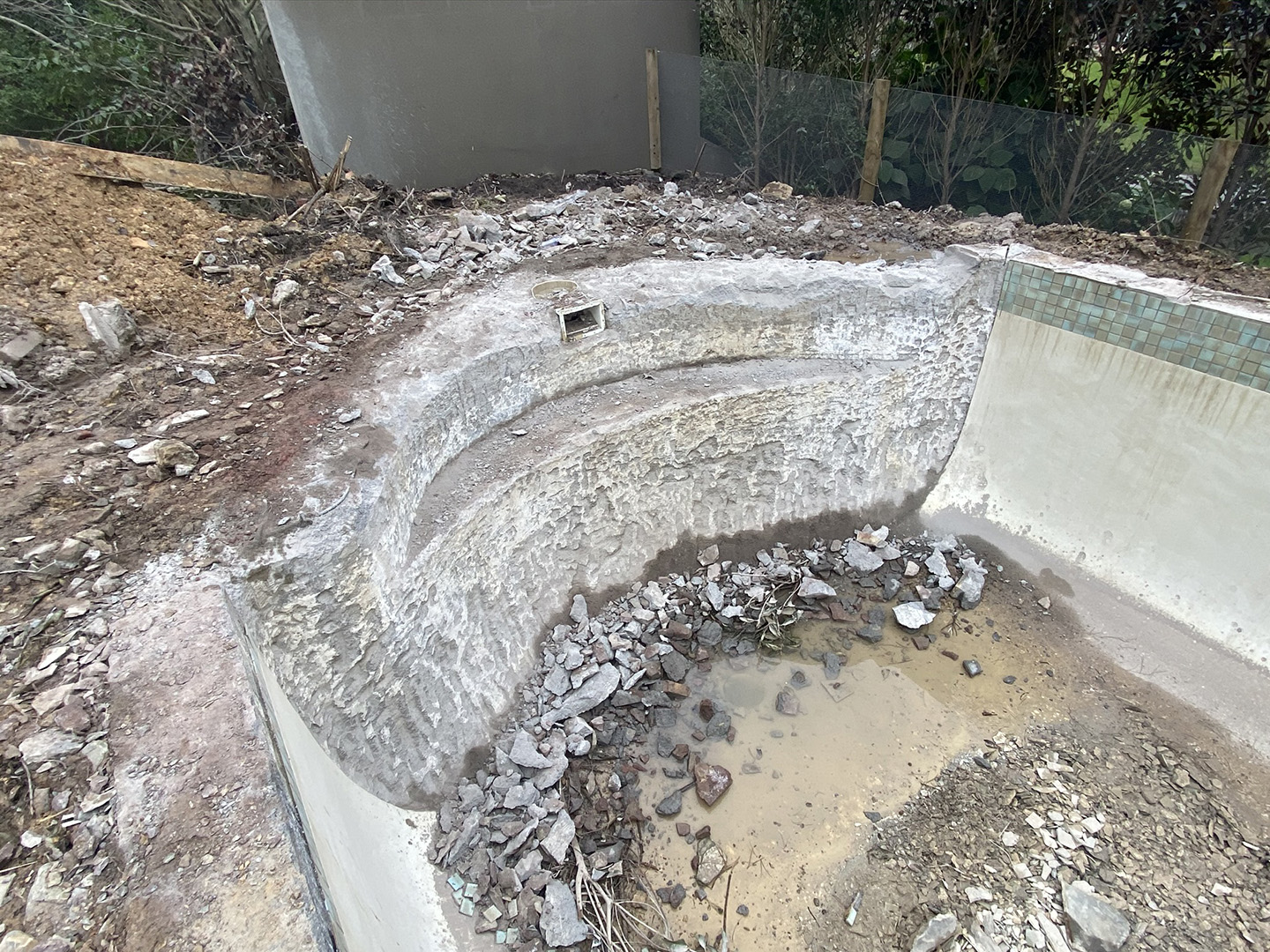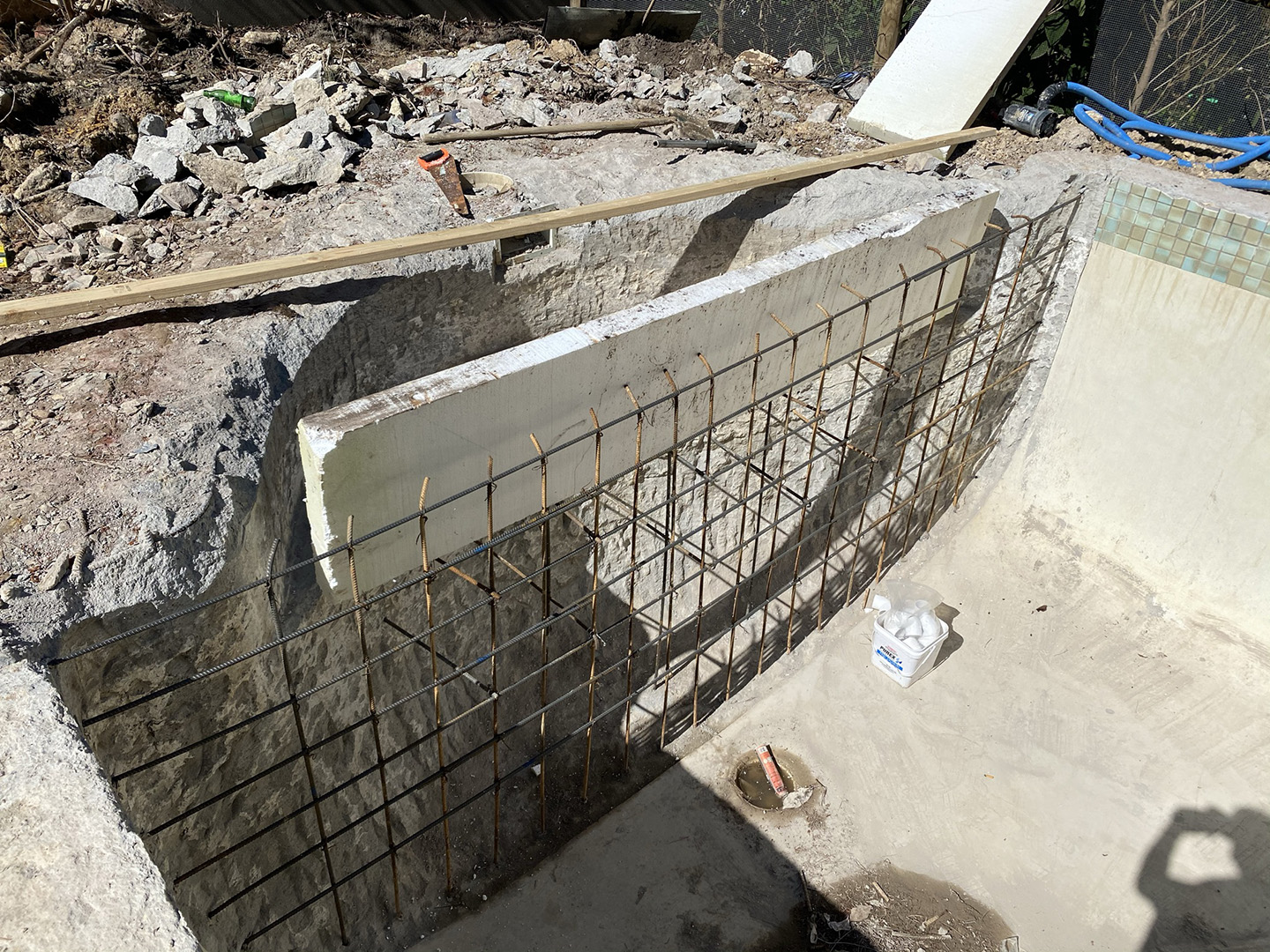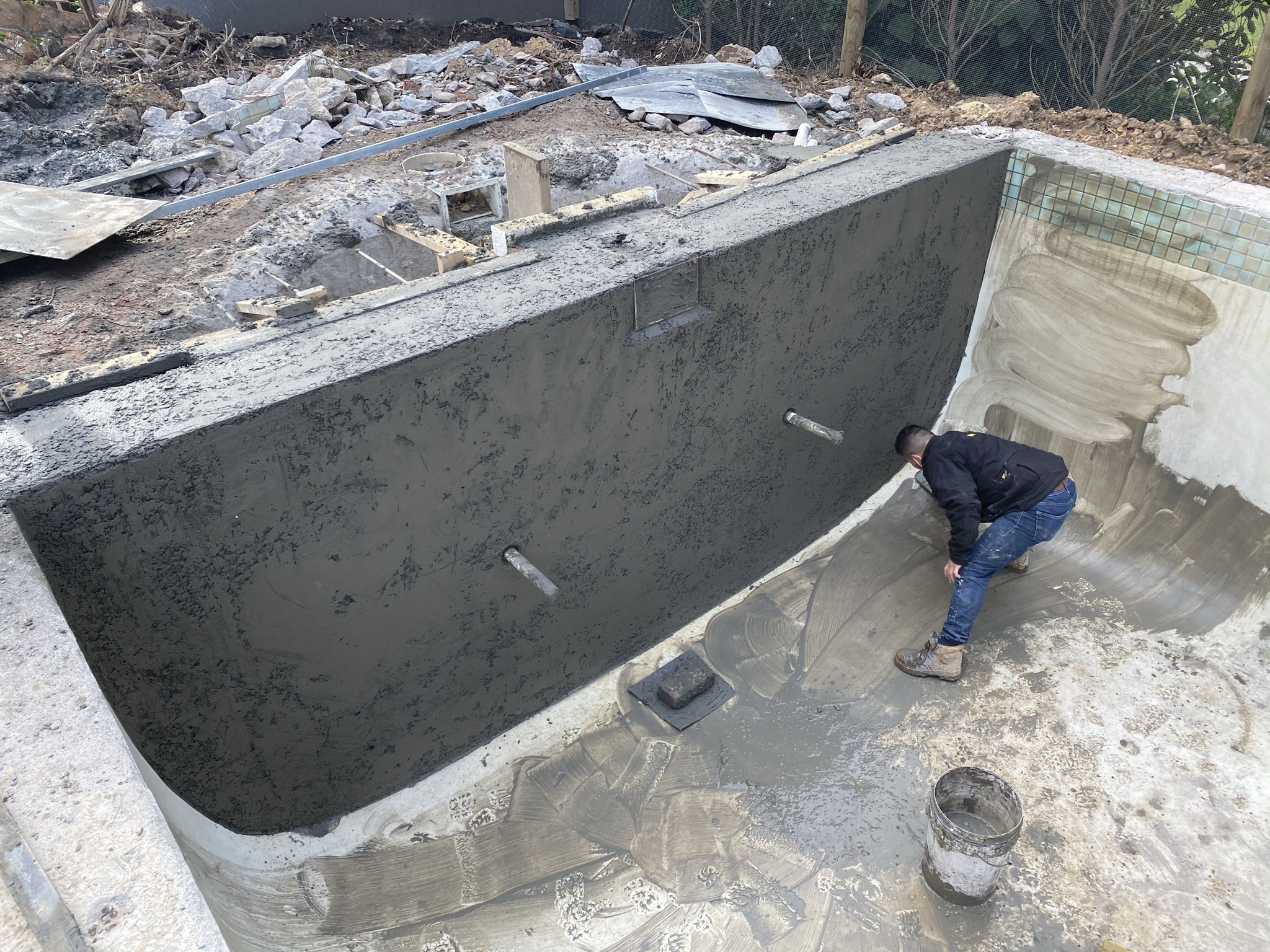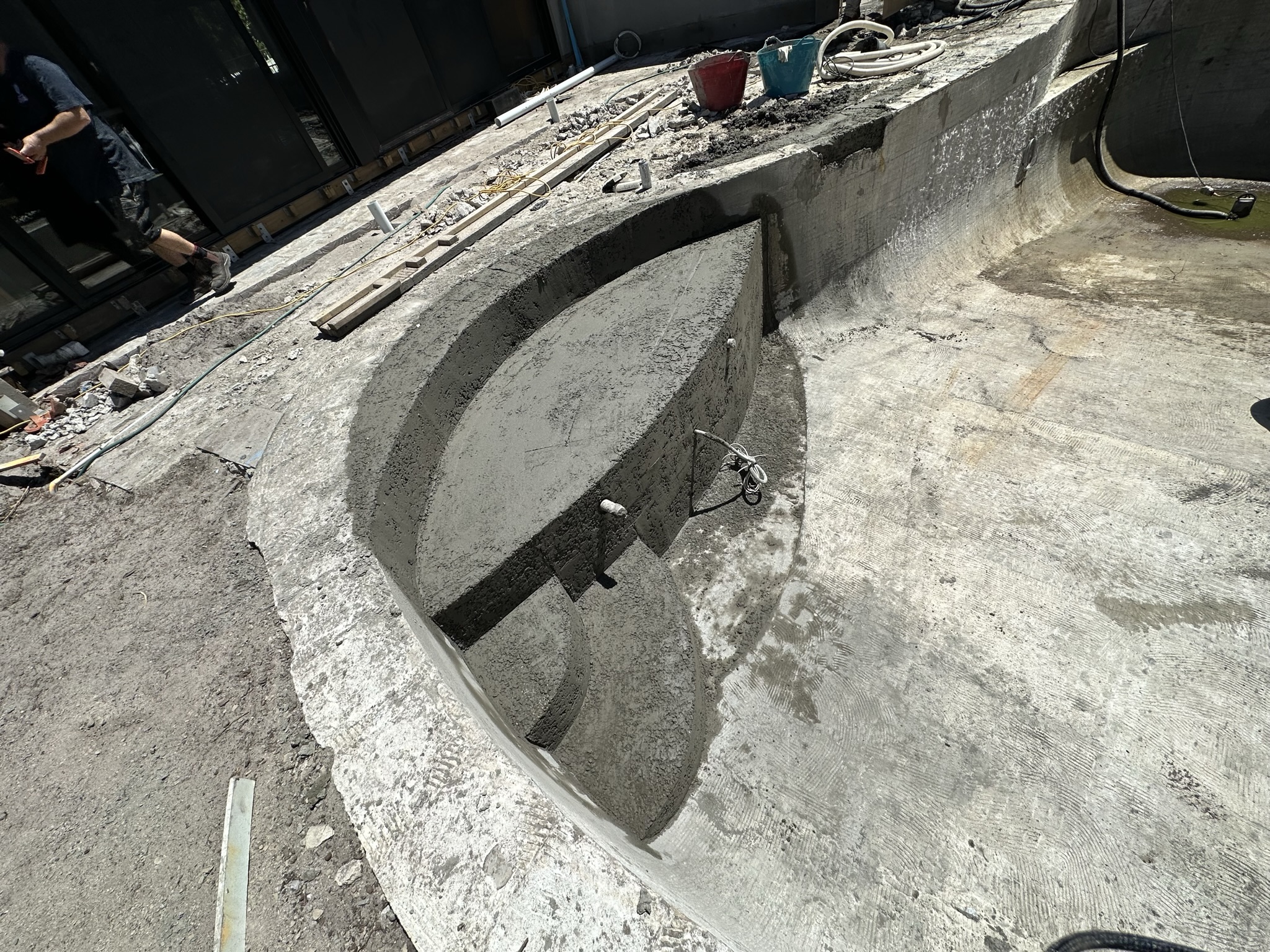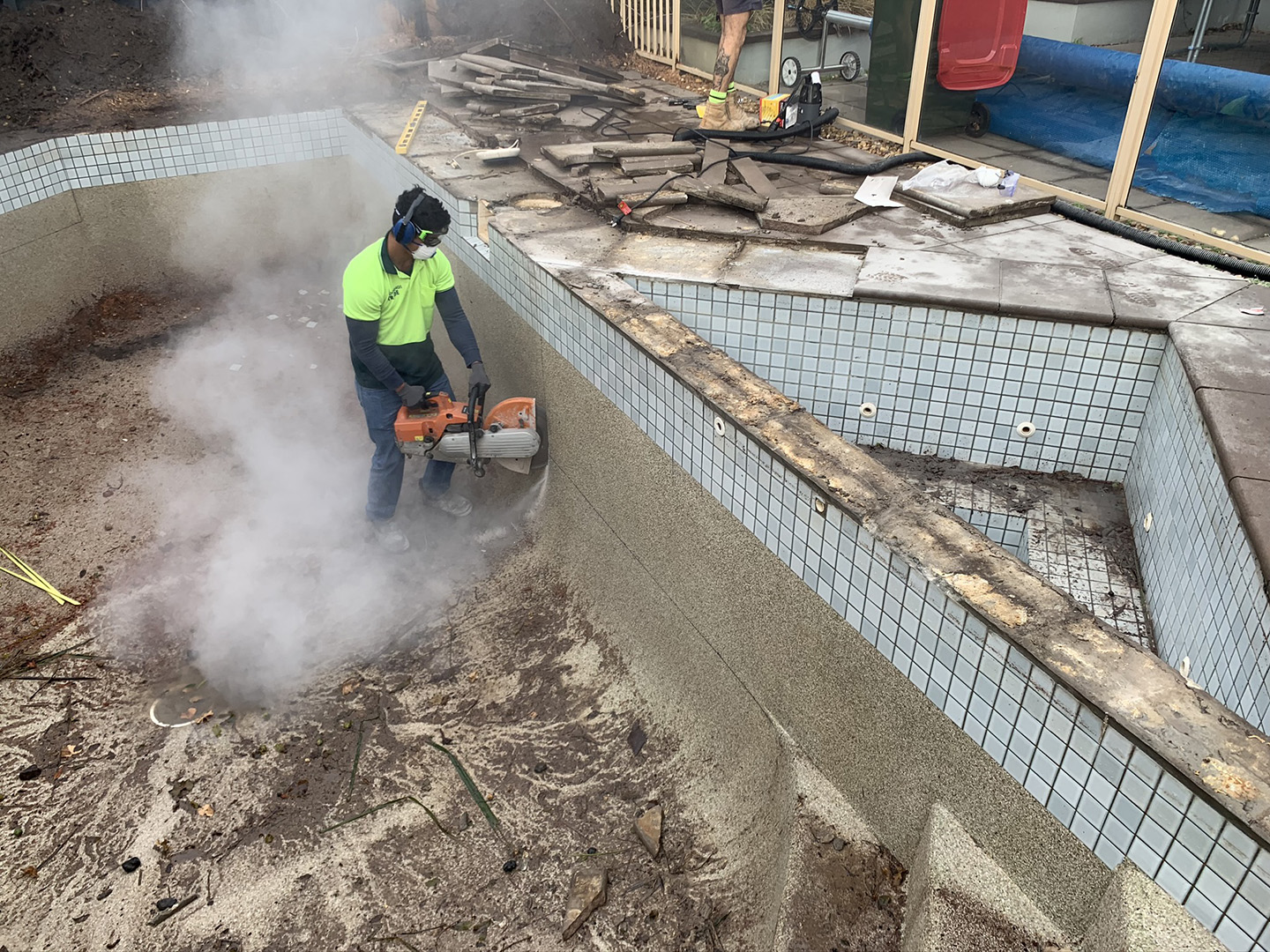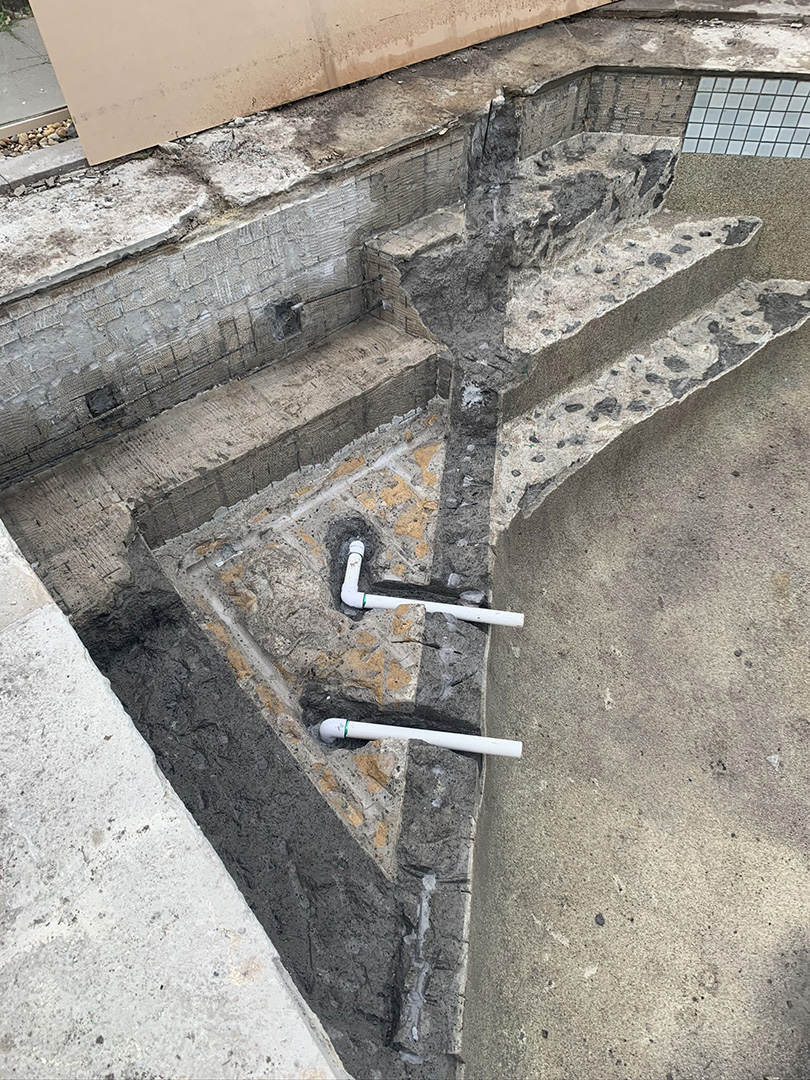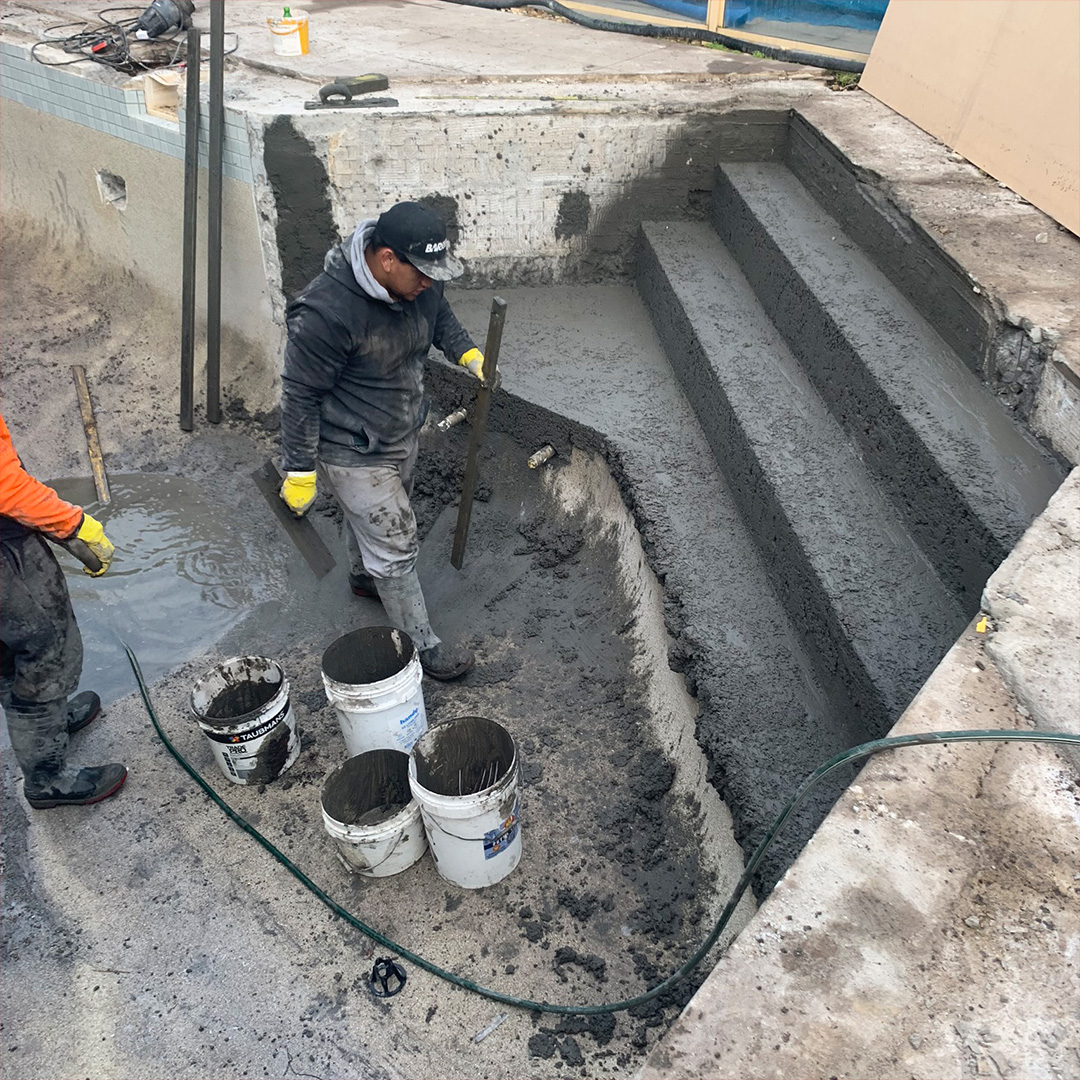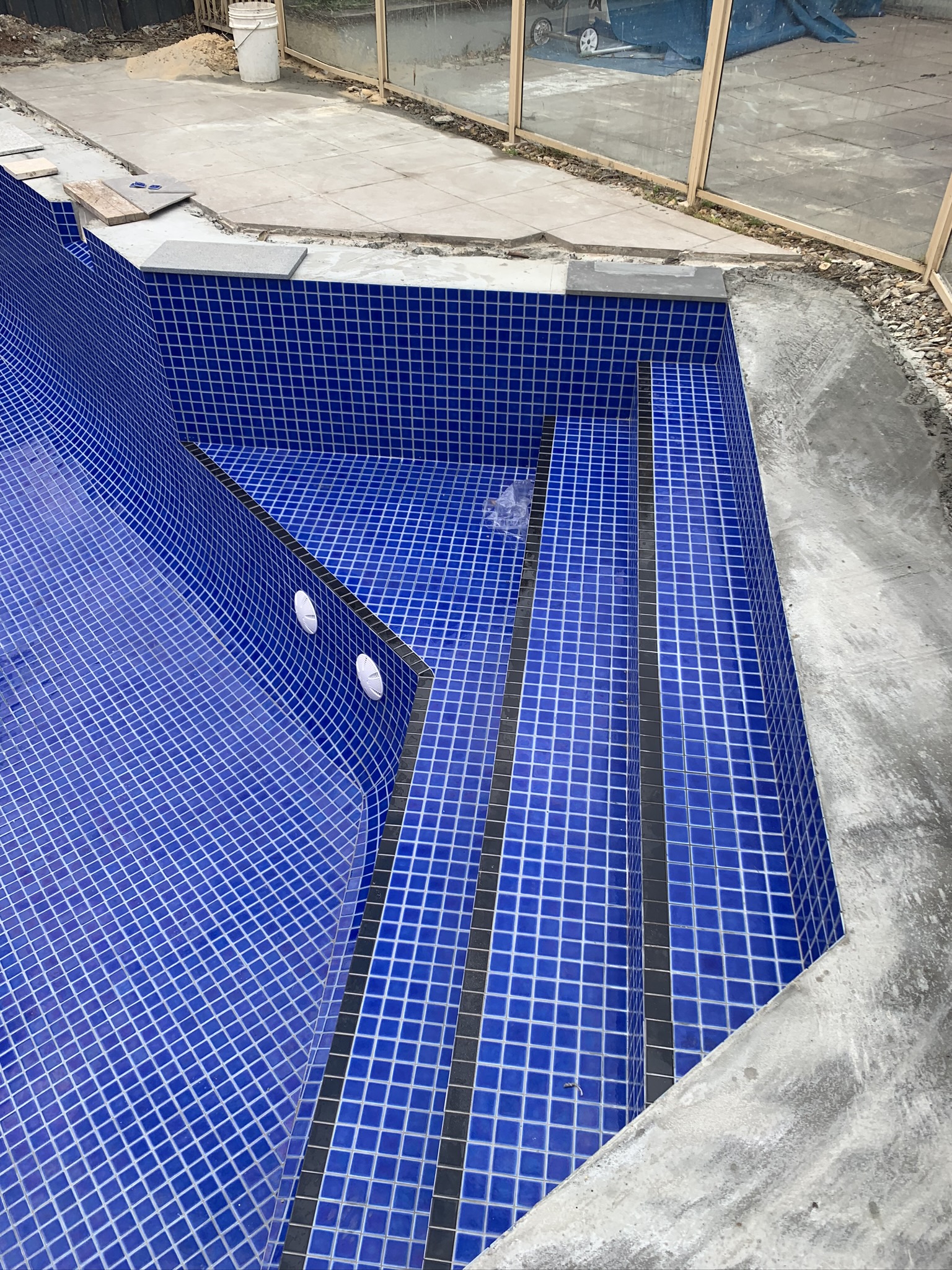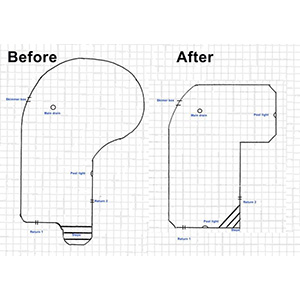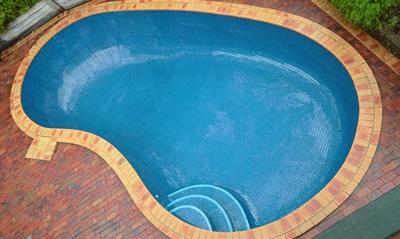


Changing the shape of a pool can be a real challenge, but for the most part worth it! We have added steps and ledges, bar stools, even changed the shape of pool walls.
Read important information below, this is a need to know before deciding to change a pool's shape.
Changing a pool’s shape creates a cold joint this is the seam where new concrete joins and meets old concrete shell. Because it’s a join, there’s a higher chance a crack can form over time if the two sections move differently.
To reduce that risk, we let the new concrete cure properly (around 28 days) before doing anything else. After that, best practice is to render, waterproof, and tile the entire pool interior.
We don’t recommend finishes like paint, pebble, glass bead, or other rendered interiors after a shape change for two reasons.
First, those finishes can’t be installed over proper pool waterproofing, because they generally won’t adhere to the waterproofing membrane required for swimming pools.
Second, if the cold joint ever cracks, you usually can’t repair just one small area & it often means redoing the entire surface.
Tiling is the best option because it gives you multiple layers of protection. The sand-and-cement render acts as a buffer layer, the waterproofing membrane seals the pool and helps handle minor movement while keeping moisture out of the cold joint, and the tiles are the final protective layer. If movement ever does cause an issue, tiles can usually be repaired in sections, instead of re-tiling the whole pool.
Yes, It's possible to change the depth and shape of your swimming pool without having to build a new pool, there may be structural limitations that may need to be respected, so in reality the true answer is decided once the pool has been inspected.
Here you can view concrete changes done to swimming pool shapes.
( 2 seperate projects )
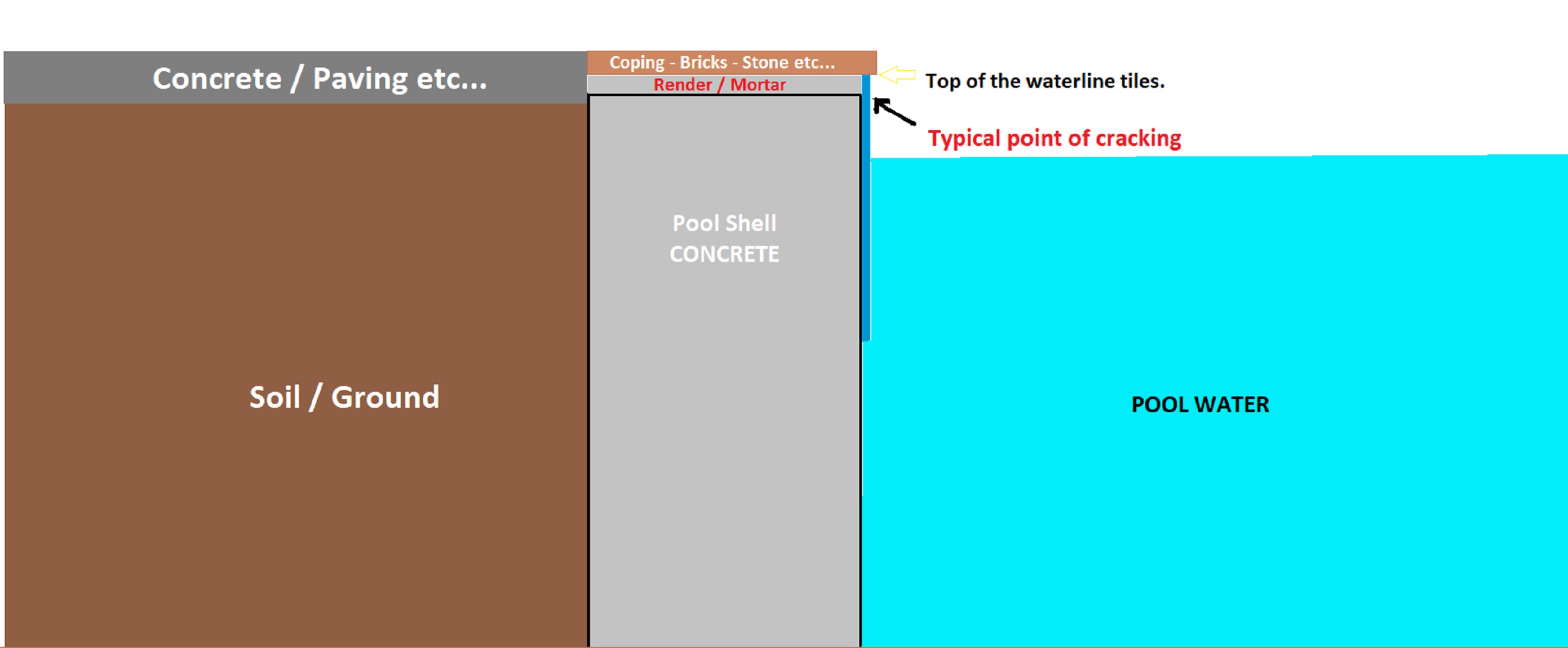
A clear understanding of concrete pool construction layers is critical to minimising future cracking.
The blue tiles in the image sit higher than the structural concrete of the pool shell below.
If the render or bonding layer separates from the concrete, stress is transferred to the tile line. This type of bond failure is known as a cold joint and commonly causes a horizontal crack along the top row of tiles, and sometimes the second row.
When new concrete is joined to an existing pool, all surface layers must be removed so the new concrete bonds directly to the original shell. Any material left between the two creates a structural weak point.
Old and new concrete expand and contract at different rates. Without a method that allows for this movement, cracking can occur and later affect the finished pool interior.
We use a proven movement management method developed and refined over more than a decade. This process is not shared publicly, as it forms part of our specialised structural repair work and is often copied without the experience required to apply it correctly.
Yes, steps can be added to an existing concrete swimming pool, but it must be done as a structural modification, not a surface upgrade.
New steps are formed by cutting back the existing pool shell, installing steel reinforcement, and pouring new concrete that is structurally tied into the original shell. All surface layers must be removed so the new concrete bonds directly to the old concrete.
Because old and new concrete move at different rates, the join must be detailed to allow for this movement. When done correctly, adding steps can safely improve access, comfort, and pool usability without compromising the pool’s structure.
Poorly executed step additions are a common cause of cracking and tile failure, which is why this type of work should only be carried out by experienced concrete pool renovation specialists.
No, a concrete swimming pool cannot be safely shortened by simply over-filling it with concrete.
Swimming pools are structurally engineered to handle water pressure, not large additional dead loads. Adding mass by over-filling places stress on areas of the shell that were never designed to carry that weight, which can lead to cracking, movement, or long-term structural failure.
No, a concrete swimming pool cannot be safely shortened by over-filling it from the shallow end.
Although less concrete is required at the shallow end, this does not make it safer. In fact, shallow sections of a pool are typically thinner and less reinforced, which means they reach their structural limits much sooner. Adding mass in this area can cause cracking with far less concrete than people expect.
Swimming pools are engineered to carry water loads, not additional dead weight. Over-filling the shallow end places stress on parts of the shell that were never designed for it, increasing the risk of cracking, movement, and long-term structural damage.
Yes, a concrete swimming pool can be shortened, but only within strict structural limits.A pool cannot be safely shortened by excessive over-filling at either end. Instead, shortening must be done by building new reinforced concrete walls that are structurally tied into the original pool shell.
In most cases, a new wall should be positioned no more than about 400 mm from the original wall. This allows the added structure to remain within the load capacity and engineering limits of the existing pool.
To achieve the maximum practical reduction, the pool can be shortened from both ends, meaning a new wall at the deep end and another at the shallow end. This typically allows a reduction of around 800 mm in total. Depending on the pool’s shape and original construction, this can sometimes be increased to roughly 500 mm at each end, shortening the pool by up to one full metre.
Anything beyond this moves outside safe structural tolerances and requires a complete re-engineering approach, not a simple modification.
No, a concrete swimming pool should not be split in half using a dividing wall.
No. Installing a dividing wall creates a permanent joint between new and existing concrete. Because old and new concrete expand and contract at different rates, this joint is highly prone to cracking, regardless of how well the work is carried out.
The problem is made worse once the pool is filled with water. The dividing wall must then resist ongoing water pressure from both sides, placing additional stress on the joint where the new wall meets the original pool shell. Over time, this greatly increases the likelihood of cracking, movement, and tile or interior failure.
For these reasons, dividing a pool with a central wall is not considered a safe or reliable method of reducing pool size, regardless of the direction of the pool this dividing wall follows.
Yes, it is possible to reduce the depth of a concrete swimming pool, but it is one of the most complex and risk-sensitive structural modifications.
We generally advise caution, as depth-reduction requests are often driven by temporary needs that can change over time and may not justify the cost involved. That said, when done properly, it can be achieved.
Reducing pool depth requires building up new reinforced concrete over the existing floor while managing rising hydrostatic pressure and internal water pressure. If water is allowed to migrate beneath the new concrete, it can cause separation, movement, or failure, which is why this type of work must be heavily over-engineered for safety.
Once the new floor is formed, the pool must be rendered, waterproofed, and fully tiled. Tiling is strongly recommended, as pool tiles are the only interior finish that can reliably bond to waterproofing membranes, especially where the pool floor has been built up.
Because of these risks, pool depth reduction should only be undertaken by experienced concrete pool renovation specialists.
Yes, it is possible to build a new pool inside an existing swimming pool, but it comes with important limitations and implications that many pool owners are not aware of.
Technically, a new concrete shell can be constructed within an old pool, usually to reduce size, change shape, or alter depth. However, pool depth and wall height are often restricted, because the new structure must safely manage hydrostatic pressure, bonding, and load transfer within the existing shell. These builds are conservative by necessity and cannot be treated like a simple cosmetic renovation.
From a regulatory point of view, this type of work is generally no longer classified as a renovation. It is considered a new pool construction. That means the pool must comply with the building codes and pool safety regulations that apply in the year the new pool is built, not the year the original pool was constructed. This can affect fencing requirements, boundary setbacks, barrier compliance, and approvals. Older pools often benefit from more flexible rules that no longer apply once a new shell is introduced.
Because of the structural and compliance risks involved, this type of project should be assessed and designed by a qualified swimming pool builder or engineer, not a standard pool renovator. While it can be done, it is one of the most complex and tightly regulated ways to change a swimming pool, and it requires careful planning before it is considered a viable option.
Yes, it is possible to change the shape of a freeform swimming pool, but there are practical limits to how far those changes can go.
In most cases, shape changes are achieved by building inward rather than outward, and there is a realistic limit to how much concrete can be added in one area. As a general rule, build-ups greater than about 500 mm are rarely recommended because of hydrostatic pressure, bonding risks, and the potential for movement over time. Beyond this point, the engineering becomes far more complex and conservative.
Some shape changes are straightforward and commonly approved, such as softening curves, removing indents, straightening sections, eliminating bays, steps, or seating areas, and tightening the overall profile of the pool. More aggressive changes, like drastically reducing width, heavily extending walls inward, or reshaping large sections in one go, may not be suitable without significant over-engineering.
Compared to freeform pools, square and rectangular pools generally allow for more dramatic shape changes. Their straight walls and uniform geometry make it easier to control load paths, reinforcement, and waterproofing continuity, which reduces long-term risk.
Every pool is different, and what is possible depends on the existing shell, soil conditions, water table, and the scale of the proposed change. When done correctly, a freeform pool can be reshaped so it looks intentional and original, not like an afterthought, while maintaining structural integrity and long-term durability.
Yes, it is absolutely possible to remove beach entries, seated areas, and built-in love seats from a swimming pool, and it is actually one of the more common shape refinements we carry out, especially on kidney-shaped and freeform pools.
These features are usually non-structural add-ons, which means they can be removed without altering the main pool shell. The process involves cutting back the existing concrete, rebuilding the area flush with the original pool profile, then re-rendering, waterproofing, and re-tiling so everything becomes one continuous surface.
From a technical point of view, this type of modification carries a lower risk than many other pool shape changes. By eliminating steps, ledges, and internal corners, you reduce the number of junctions where movement or waterproofing failure can occur over time. The finished result is cleaner, simpler, and more durable.
Visually, when done correctly, the pool does not look modified or patched. It looks as though it was always designed without those features. Many owners choose this change to modernise older pools, improve swimming space, or remove areas they no longer use, while also simplifying long-term maintenance and reducing potential leak points.